Business and investors are inundated with the themes and narratives that dominate today’s headlines: Persistent inflation, geopolitical conflict, rising interest rates and the transformative potential of artificial intelligence. For many, it has become difficult to separate signal from noise.
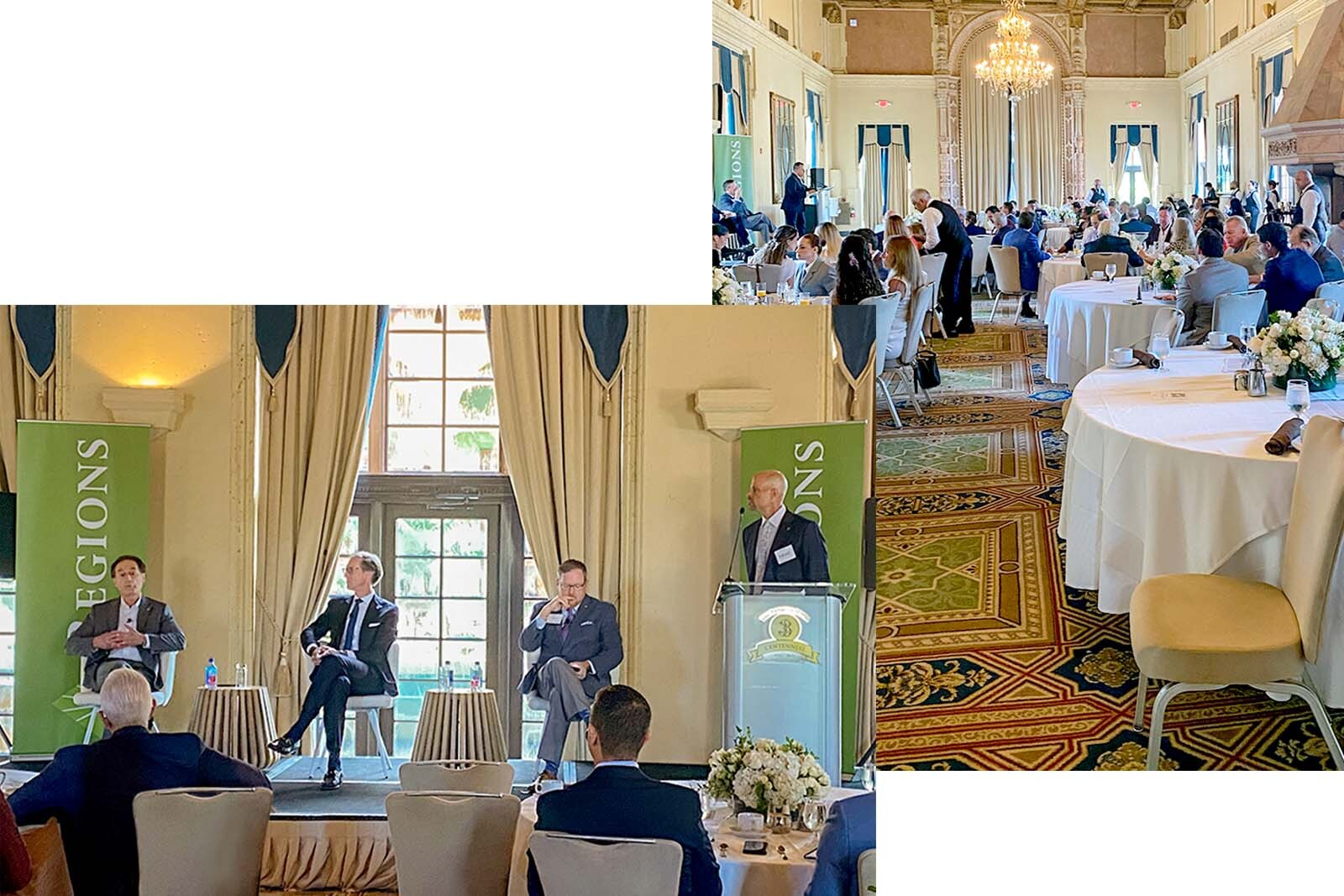
This ongoing uncertainty was the focus of the Miami Economic Outlook Summit, hosted by Regions Bank on Sept. 10. Regions representatives met with clients, business leaders and advisors to discuss the forces that will shape the economy and financial markets in the months ahead.
Panelists included Regions Chief Investment Officer Alan McKnight; Regions Chief Economist Richard Moody; and Jason Isbell, Regions head of State Government Affairs and Economic Development. Moderators for the event were Axel Rizo, Regions Private Wealth Management, South Florida and Ernie Roque, Regions Commercial Banking Lending, South Florida,
As Rizo noted, business planning requires evaluating future risks, opportunities and trends. As he told attendees, inflation “measures historical data,” while sound decision-making depends on assessing future trends and calculated risks.
That theme resonated as Roque posed questions throughout the event. While panelists acknowledged challenges facing the economy, they also emphasized that many of the underlying fundamentals remain stronger than some headlines might suggest.
A Two-Speed Economy
Despite a steady stream of economic concerns, the U.S. economy continues to grow.
According to Moody, real gross domestic product has expanded at an average annual rate of 2.25% over the past eight quarters, matching the average growth rate experienced during the record-long economic expansion that preceded the pandemic.
Yet that growth has been far from uniform.
“Not all parts of the economy are moving in the same direction nor at the same speed,” Moody added.
Business investment remains a key source of growth, particularly those tied to artificial intelligence, data centers and digital infrastructure. At the same time, consumer spending has remained resilient throughout much of 2026, even though economists expect moderation in the quarters ahead.
At the same time, housing continues to face significant pressure from mortgage rates approaching 7%, while many forms of commercial construction outside of data-center development remain subdued.
The result, according to Moody, is “very much a dual-speed economy.”
The panel spoke to expectations by investors about the promise of AI investment. Panelists expressed optimism that, over the long term, productivity gains resulting from AI adoption and broader capital investment could eventually help push growth above the current trend rate.
For now, the economy appears likely to continue expanding at roughly the pace it has maintained over the past two years.
Not all parts of the economy are moving in the same direction nor at the same speed.
Richard Moody, Regions Chief Economist
Political Gridlock: Good for Business
With midterm elections approaching, questions about Washington’s impact on the economy and markets were top of mind for many attendees.
Based on historical trends and current polling, panelists discussed the possibility of a divided government, with Democrats potentially gaining control of the House while Republicans retain the Senate. Isbell noted that a historical trend is that the president’s party loses seats in both houses of Congress in mid-term elections, often leading to a divided government.
From an investment perspective, that outcome may be more favorable than many assume.
“A divided government is not the worst thing when it comes to the markets,” Isbell said. “There’s much more predictability” because major policy shifts become more difficult to enact.
McKnight noted that certain historical periods of divided government have coincided with strong stock market performance.
As Isbell observed, political gridlock often limits dramatic shifts in public policy. While that may frustrate policymakers, it can provide businesses and investors with greater visibility into the future.
In the short term, markets may experience volatility as election season unfolds. Over the longer term, however, it could help support a more stable operating environment.
A divided government is not the worst thing when it comes to the markets. There’s much more predictability.
Jason Isbell, Regions head of State Government Affairs and Economic Development
Interest Rates and Inflation: A Return to Normal?
Inflation remains one of the defining economic stories of the past several years, exceeding the Federal Reserve’s 2% target every month for more than five years
Panelists pointed to a series of supply-side disruptions that have helped keep inflation elevated. The COVID-19 pandemic damaged global supply chains while government stimulus simultaneously fueled demand. The war in Ukraine pushed energy costs higher, and changes in trade and immigration policy altered labor and production dynamics. More recently, geopolitical tensions in the Middle East have added even greater pressure to energy markets.
“The economy has been through a series of repetitive supply-side shocks that have helped sustain inflation pressures,” Moody said.
With the resurgence of inflation, long-term interest rates have risen sharply. But the Federal Reserve may have limited powers to curb inflation, because many of the factors currently driving the rise remain outside the central bank’s control. Raising interest rates may influence demand, but it cannot resolve energy disruptions, expand labor supply or reopen key global trade routes.
Panelists also attributed increases interest rates to several factors beyond inflation, including growing government borrowing needs around the world, rising demand for capital and significant debt issuance tied to AI-related investments. In short, the days of abundant liquidity and strong central bank intervention appear to be fading.
Moody noted that years of unusually cheap money allowed some businesses and investments to access capital under conditions that would otherwise prove unsustainable.
McKnight added that many of today’s investors have spent most of their careers operating in an environment where rates were artificially low.
Rather than representing a new economic reality, today’s interest-rate environment may actually signal a return to more historically normal market conditions, one where rates are driven primarily by the supply and demand for capital rather than central bank support.
The transition may be uncomfortable, but panelists suggested it is one business and investors need to anticipate.
Rather than representing a new economic reality, today’s interest-rate environment may actually signal a return to more historically normal market conditions.
Earnings Remain the Key Market Driver
Despite concerns surrounding inflation, rates and politics, corporate earnings have remained very strong.
That strength has been a primary catalyst behind stock market gains, even as investors navigate an increasingly complex economic backdrop. Much of the market’s resilience has come from companies continuing to deliver revenue growth and profitability that exceed expectations.
Looking ahead, the question is whether that trend can continue. As McKnight explained, investors are closely watching whether companies can maintain profit margins, continue growing revenues and improve productivity.
While economic growth remains modest, nominal spending has been considerably stronger, helping support top-line results across many industries. Moody and McKnight noted that inflation-adjusted growth and nominal growth paint very different pictures of the economy, helping explain the disconnect between moderate GDP growth and strong corporate earnings.
The discussion repeatedly returned to productivity as a critical factor.
“Businesses that successfully leverage technology to improve efficiency, reduce costs and increase output may be better positioned to sustain earnings growth even in an environment of higher borrowing costs and slower labor-force expansion,” Moody said.
For now, companies continue to demonstrate resilience. But panelists acknowledged that the months ahead will likely reveal whether productivity gains are sufficient to offset persistent economic headwinds.
Businesses that successfully leverage technology to improve efficiency, reduce costs and increase output may be better positioned to sustain earnings growth even in an environment of higher borrowing costs and slower labor-force expansion.
Richard Moody
The Labor Market’s Unusual Balancing Act
Few aspects of the economy are generating as much debate as the labor market.
When asked to characterize current conditions, Moody offered a one-word assessment: “Confusing.”
Job growth has slowed significantly compared with those years immediately following the pandemic. Yet unemployment remains low, and layoffs remain below pre-pandemic norms. The explanation lies in what economists often describe as a “low-hire, low-fire” labor market. Firms have become more cautious about adding workers but have also become reluctant to let workers go.
A key reason? Labor scarcity.
Panelists pointed to shifting immigration patterns, an aging workforce and decades of declining birth rates as forces constraining labor supply. In fact, Moody noted that the labor force had, so far in 2026, contracted by 600,000 from beginning of the year, making it increasingly difficult for employers to fill open positions. That shortage has been made more acute with increased immigration enforcement.
That reality explains why productivity emerged as one of the seminar’s most important themes. With labor-force growth increasingly constrained, businesses and the broader economy will depend more heavily on technology, innovation and efficiency improvements to support future expansion.
With labor-force growth increasingly constrained, businesses and the broader economy will depend more heavily on technology, innovation and efficiency improvements to support future expansion.
Miami Finds its Footing
The panel also devoted time to the South Florida economy, which has recently faced many of the same pressures affecting the nation along with some uniquely local challenges.
According to Moody, Miami is beginning to regain momentum after a difficult stretch marked by slower migration, housing affordability challenges and policy-driven disruptions to trade and labor flows.
Housing remains a significant issue. Although area home prices softened briefly over the past year, overall elevated prices combined with mortgage rates near 7% continue to create pressure on affordability across the region. Those same dynamics have contributed to a pullback in single-family construction activity and have made workforce availability more challenging for employers.
Still, Moody described Miami as a diverse and business-friendly economy with strong demographic and infrastructure advantages. While growth is unlikely to match the extraordinary pace experienced between 2022 and 2024, the region’s role as an international business and trade hub continues to support a strong long-term outlook. As Moody put it, “the local economy is regaining its footing.”
For business leaders and investors, that may have been the seminar’s most important takeaway. Whether examining national economic trends or the outlook for high-growth markets such as Miami, the underlying message remained consistent: uncertainty is unavoidable, but informed decision-making remains a competitive advantage. By focusing on productivity, innovation, disciplined planning and long-term fundamentals, organizations can position themselves to navigate whatever headlines come next.
Uncertainty is unavoidable, but informed decision-making remains a competitive advantage.
This material is provided for informational purposes only and is not intended to be accounting, legal, tax, investment or financial advice. Although Regions believes this information to be accurate as of the date written, it cannot ensure that it will remain up to date. The views and opinions expressed are those of the speakers as of the date presented and are subject to change without notice. Forward-looking statements are based on current assumptions and expectations and are subject to risks and uncertainties. Actual results and market performance may differ materially from those discussed. Investing in securities involves risk, including the risk of loss. This information should not be construed as a recommendation or suggestion as to the advisability of acquiring, holding or disposing of a particular investment, nor should it be construed as a suggestion or indication that the particular investment or investment course of action described herein is appropriate for any specific investor.