Skip to Main Content
Doing More Today
  • News
  • Community
    • Associates in Action
    • Community Engagement
    • Small Business
    • Economic Development
  • Insights & Innovation
    • Economic Commentary
    • Insights
    • Innovation
  • Financial Wellness
    • Financial Wellness
    • Fraud Prevention
  • See the Good
    • Culture
    • Good Company
    • Good Towns
    • Good Pets
    • Ecards
    • Recipes
    • Riding Forward
    • The Extra Mile
Subscribe Now
Regions Bank

Regions Bank: Doing More Today: Good stories. Better insights. More possibilities.

Share
Share on Facebook
Share on X
Share on LinkedIn
Subscribe
illustration of cyber hygiene
Category: Fraud Prevention

3 Steps to Better Cyber Hygiene

It begins with taking responsibility and coming up with a plan in case you become the target of a cyberattack.

By Doug Segrest | June 9, 2021

Business in 2021 isn’t business as normal. There are challenges everywhere.

And those include silent adversaries who want access to your business or organization, including your most sensitive information. That’s why good cyber hygiene has never been more important.

“You must ask, in big bold letters, who is ensuring that the necessary protections and ongoing education are in place for your business or nonprofit?” said Ken Valentine, Corporate Security senior manager for Regions Bank. “You need a steady drumbeat, but that becomes background noise if no one is responsible for taking the steps to stay safe.”

So, whether you run a small business or nonprofit, good cyber hygiene can help ensure business as usual and help reduce the risk of a cyberattack. Just consider these three steps:

  1. Build a culture of cyber readiness – Don’t make precautionary efforts the exception. Make them routine. That means scanning for viruses, updating systems regularly and using strong passwords that are routinely changed. You invest the time and the resources to make it the norm.
  2. Implement an employee awareness and training program – Teach your staff what to recognize, how to react and why it’s important everyone works together.
  3. Develop a cyber governance and event response plan – No matter how good you think your cyber hygiene may be, you’re coming up short if you don’t plan for contingencies. Game plan worst-case scenarios and know the steps you need to take to resolve the issue.

“Building a culture of cyber readiness is critical to awareness and response. Understanding the potential risks, educating employees, and having a response plan are key steps to prevention and recovery, said Jeff Taylor, head of commercial fraud forensics for Regions Bank. “Neglecting to prepare can make your business even more vulnerable.”

Another great resource is the Cybersecurity & Infrastructure Security Agency (CISA). The government organization has a great checklist, with tips on how you can self-test to reduce the risk of a cyberattack. Just go to this link: Cyber Hygiene Services | CISA.
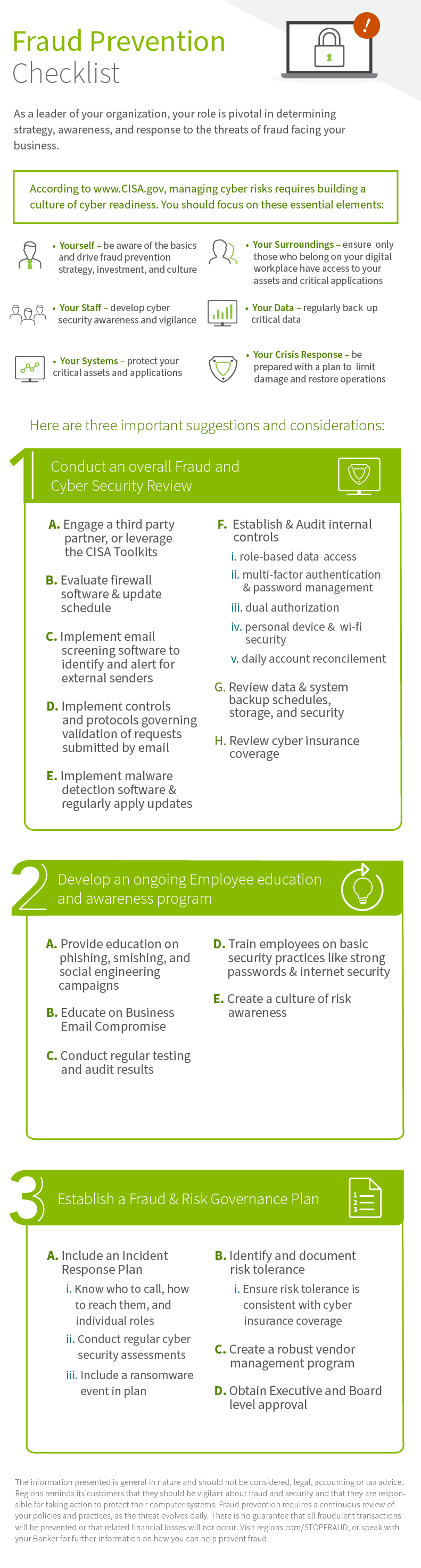
fraud prevention cyber hygiene infographic

Share
Share on Facebook
Share on X
Share on LinkedIn
Subscribe

Trending Articles

  • 1.

    Unboxing Evergreen Gifts: How Regions Delivers Appreciation to Nearly 20,000 Associates

  • 2.

    When Fraud Strikes, Education Can Be a Customer's Best Defense

  • 3.

    New Tax Rules and Individual Giving Trends: Key Insights for Nonprofits

  • 4.

    American Banker Honors Regions’ Kate Danella as One of the 25 Most Powerful Women in Banking

  • 5.

    Building Better Lives Through Affordable Housing

Related Articles

Person points to an investigation-style board filled with scam-related clues...
Category: Fraud Prevention

#BanksNeverAskThat: Spot Scams. Slay Scams.

Shannon Powers, a Technology Field Services technician in Jackson, Tenn.,...
Category: Community Engagement

Turning Skills into Impact

An illustration of various characters of different gender, ethnicity and...
Category: Community Engagement

Back to School, Beyond the Classroom

Liz Edwards, vice president of Philanthropy at the Community Foundation...
Category: Community Engagement

New Tax Rules and Individual Giving Trends: Key Insights for Nonprofits

A document with warning exclamation sign indicating reporting an issue.
Category: Fraud Prevention

Why Reporting Fraud Matters, Even If You Didn't Fall for the Scam

Background overlay of fraud event in Nashville with fraud related...
Category: Fraud Prevention

Fighting Fraud: ‘This is Personal, Professional and Meaningful’

Book with security shield in the middle with surrounding fraud...
Category: Fraud Prevention

When Fraud Strikes, Education Can Be a Customer's Best Defense

Person holding food tray and exterior building of Mid-South Food...
Category: Community Engagement

The BLOC’s Secret Sauce

Regions.com | About Regions | Investor Relations | Privacy & Security | Website Terms of Use | Online Privacy | Contact Regions | Careers at Regions
Non-deposit products including investments, securities, mutual funds, insurance products, crypto assets and annuities:
Are not FDIC-insured
Are not bank guaranteed
May lose value
Are not deposits
Are not a condition of any banking activity
Are not insured by any government entity
© 2026 Regions Bank. NMLS 174490. 1900 5th Avenue North, Birmingham, AL 35203. All Rights Reserved.
Regions, the Regions logo, and the LifeGreen bike are registered trademarks of Regions Bank. The LifeGreen color is a trademark of Regions Bank.
Equal Housing Lender Member FDIC